Wednesday, 27 August 2008

The Origin of the Layout

The idea for Port na Cailliche came from my original layout Invercloy which was supposed to be a terminus at one end of a ficticious West Highland narrow gauge line. I enjoy reading about people's layout's when they've made a ficticious history to accompany them and use this to justify and describe certain aspects of the layout. The one that particularly springs to mind is the Craig & Mertonford Railway by P.D. Hancock where he created a ficticious history of the line for pertty much every aspect of it. Another that has also interested me to read about is Ted Polet's Craigcorrie & Dunalastair Railway, this has been a huge inspiration to me and has been very interesting to see develop over the time that i have been a member of the 009 Society.

These two layouts got me thinking about the origin for the railway that would operate through Invercloy. I can up with some ficticious names for Scottish towns and villages to have stations based in, and these were then used to form the company name (the Ardaig Bay Joint Railway Company). Two stations on this line have been modelled so far, Invercloy which was never finished, and still remains in that state, and Dunbracken which is currently under construction. Dunbracken is based on an ironing board and is a very basic layout.

Dunbracken was built as a learning exercise for Port na Cailliche, i always wanted to build a bigger layout, but at the time didn't think my modelling skill would be good enough to undertake such a task. Hence the building of a small layout as a learning exercise, and being the first layout that i've built entirely on my own i'm very pleased with it. There are several aspects which i had not tried or used before that i wanted to have experienced before i decided to use them on PnC, these included Rock castings, making water, DCC, building a ship and generally improving my ability with creating decent scenery. Not a small list, so i thought that a new layout was worthwhile, especially if it was small.

Back to the basis of the layout... The ABJR was formed from two separate companies, the Glencloy Light Railway Company, and the Ardaig Bay Railway Company. The GLR ran from Invercloy to Ramasaig, with a small branch to Dunbracken, while the ABR ran from Port na Cailliche to Ardaig where it connected with the Highland Railway. The ABR claimed the majority of the title of the new Joint Companie's monicker due to their higher level of fiscal solvency than the GLR. The locals often commented that if the two hadn't merged then they thought the GLR would have closed long before it did.

Both lines were separated by a small range of mountains in the centre of the headland which they both ran along either side of.

At some point in their history the two companies decided to merge and constructed a line through the glen of the mountain range to connect to each other. At one end of these glens sat Port na Cailliche, so this is actually a junction station, but the line up the glen joins some distance out of the station (so this may feature on a future extension).

Due to the two initial lines running along the coast they were blessed with fairly easy gradients, and therefore could afford the use of smaller sized locomotives, however with the construction of the line linking the two along the glens so more potent motive power was required. This was provided in the form of large tank engines and a small group of tender locos, and even a garratt for heavy mineral trains.

This operation effectively created two eras for these lines, one of independence, and one of operation as the joint line. During the time of the jont company stock still mainly operated over the lines it was originally used on, but occassionally it would be required to venture further afield on the rest of the system. The larger stock bought by the joint company could be operated over the whole system, though it seldom saw use on the Dunbracken branch due to the size of the terminus at Dunbracken.

Of course this is all fiction, but it gives reason for the ficticious town of Port na Cailliche to have a station like the one i'm proposing to build for this layout. I find knowing the sort of line you are portraying helps to decide things like the stock, how well maintained it should be (also dependent on the era you've modelled), how to operate it and many other things. I've found it quite enjoyable coming up with this little history for the line and will expand on it bit by bit, if you're interested in writing a history for your line then Ted Polet wrote an interesting article on doing so which appears in the Modeller Book of Narrow Gauge, and is well worth a read.

Port na Cailliche was chosen as the site for the larger layout as i thought it would be an ideal place to indulge my love of scenery, sited on the coast with a glen approaching the sea, rocky outcrops, a town and plenty of water. Plus being at one end of the joint line it would have seen all sorts of the stock operating so would allow me to build up a varied collection of locos and rolling stock.
Hopefully one day i'll have enough room to add the extension with the junction on it, but i've got enough work now finishing Dunbracken and with the plans for the 4 boards of this!

Monday, 18 August 2008

A rainy holiday miles away from Scotland proves fruitful!

Might sound like a strange title for a blog post, but... i've just returned from visiting my mum (who lives on the edge of Dartmoor) for a week and a bit's holiday. Unfortunately it rained a lot so we couldn't go and do as much as we'd planned for the time we were there, but it had it's bonusses, my girlfriend read a book she's been wanting to for ages, and i finalised the trackplan for the layout, and looked through lots of my old railway books!!

Whilst I had intended originally to have the layout on a much sharper curve, from talking to other narrow gauge modellers about my ideas i've decided to smooth it out and have a much gentler curve for the trackwork. To accomodate this i've had to ease the shape of the layout away from an L shape to what might be likened to a banana shape. The idea is that the fiddle yard end of the layout sits some distance away from the barrier at an exhibition (while being close enough to see all the details!), and it then curves and comes to a stop at the station end much closer to the barrier.

I also went to Plymouth model railway exhibition, whilst there wasn't anything particularly inspiring there from a narrow gauge point of view, i bought a few bits and pieces which will be useful. As i said before i'm planning on building a new body on the Roco loco that i bought recently, this will be freelance, but a 2-6-2T which is very much inspired by the Ballymena & Larne compund locos built by Beyer Peacock (albeit with smaller wheels and outside frames). More details will follow on this in subsequent blog posts.

Finally, i visited a friend who has leant me two superb DVDs, those on Scenery techniques produced by Paul Scoles. They are superb and cover all sorts of scenic techniques in an easy to follow and well explained manner.
Paul uses dirt for covering his scenic hard shell, and applies this dry to the slopes of the hard shell, lets it settle whilst gravity does it's work and then wets it and glues it in place. This provides as natural an 'earth' as possible in my mind, where the material has settled to the angle which it would in real life (ok, so grain sizes are slightly different which will have an impact, but it's sieved beforehand so it's nice and fine). Examples of Paul's scenery techniques are visible on the galleries of his Pelcian Bay Railway & Navigation Company.

This is something i might consider for PnC, but i'm not entirely sure as yet, it could potentially add a LOT of weight to the boards, but it does look very good...

Monday, 28 July 2008

Another layout that's got me thinking!

Whilst on a visit to a local model shop at the weekend I picked up a copy of the April 2008 Continental Modeller which i obviously missed first time around. In it there's an article on a French layout named Pempoul (metre gauge in 1:50 scale) built by Gordon and Maggie Gravett. The scenery on Pempoul is fantastic, i had seen pictures before, and when i saw the article that explained some of the Gravett's methods i had to buy it!

Some pics of Pempoul on these sites:
Crawley MRS
World Rail Fans
RMweb

I've just noticed it's going to be at ExpoNG (Swanley) later this year so will be able to take it all in then!

Two things in particular stand out for me, firstly the grass. This is done using a Noch Grasmaster which electrostatically charges the flock powder so that it stands on end when dropped into some adhesive on the layout, the difference between this and the old puffer bottle for flock is quite noticable. This looks particularly good for representing fine grass, but i think for the more moorland areas i'll stick to longer carpet underlay to achieve the more rough look.

The only thing putting me off getting a Grasmaster for PnC is the £100+ price tag... some experimenting with a balloon and something to rub it on before i go down the Noch path i think!

The other thing that struck me about Pempoul was the colouring and the fact that it's so subdued. Layouts with bright colours on stick out like a sore thumb, both vegetation, buildings and other scenic items need to appear more subtly coloured. After all they are being viewed at well over several hundred scale feet away most of the time so they should appear in model form as they do in real life over this sort of distance, not how they do when viewed up close.

Upon realising this i looked back through my modelling books and found a useful introduction to colour in Dave Frary's How to Build Realistic Model Railroad Scenery. However i feel that this is an area that military modellers generally achieve much better results than railway modellers, so i will be looking at this source for more information.

Pempoul has also made me think about baseboard construction, it's boards are 4 and 9mm ply around an extruded polystyrene core. Extruded polystyrene is not the white polysytrene used typically for packaging in the UK, but the coloure foam you can get for housing insulation (amongst other thigs). An example of it in use on a layout is this shot of the latest section of County Gate under construction by John de Fraysinnet.

Whether this approach will be lighter than the initial thought of ply and foamboard formers i'm not sure, but i believe it will be infinitely stronger due to it's more solid construction. The only area i can see being an issue is mounting the point motors, this could be done by having cross braces etc. where these are needed and mounting them on these. American modellers use this material much more than us in the UK, i'll try and find some info on mounting point motors from some US sites.

Hopefully i can find out more about the construction of Pempoul's boards at Swanley.

And a brief update on the Roco... it's been run in for about 5 hours now, and it will run soooo smoothly and will crawl round my circular test track even when controlled by my old H&M clipper, so it will be 10 times better when hooked up to DCC!

Tuesday, 22 July 2008

Improved running

One 009 myth that i'm keen to dispell in the operating of this layout is that the running is poor. With the quality of mechanisms nowadays it is possible to obtain very small gauge locos which will run smoothly. Unfortunately at present 009 isn't that well served for ready to run prototypical chassis, with the 009 modeller having to rely on converted N gauge chassis (often inside framed), etched brass kits or using HOe mechanisms.


Roco 0-6-0 tender loco source: http://www.roco.com/


I have just bought one of the latter, a Roco 0-6-0 tender loco (shown above) which has outside frames, brass flywheel and complex valve gear, therefore something prototypical and suitably large for a railway in the Scottish Higlands can hopefully be built on it.

I'm not 100% sure what will be built on this, but it is likely to be either an entirely freelance loco, or a standard design from either Hunslet, Hudswell Clarke or Manning Wardle reproduced from the reproduction Catalgues i've got from Plateway Press. At present the thinking is to produce a large tank loco (2-6-2T or similar) and use the tender for another project at a later date.

John de Frayssinet has sucessfully used these chassis under his Manning Wardle and "Russell" Backwoods Miniatures kit based locomotives on County Gate, so if all goes well with this one then i might buy some more and make a small loco stud of 3 or 4 locos out of them.

The running is extremely smooth, and will give a much more prototypical feel than the stock which earned 009 it's undeserved reputation amongst other modellers all those years ago. Hopefully the running can even be improved upon slightly by the addition of a Zimo DCC decoder which will allow me to limit the top speed and give more fine control of the speed of the loco. More on this once the loco has arrived.

For other wheel arrangements i shall be looking into using several sources of loco chassis, the first being converted Japanese N gauge locos (Tomix, Kato, Micro Ace etc) with dummy outside frames, all these run superbly, much smoother than European N gauge stock.

Converting a Hollywood Foundry Bullant to outside framed is another option, as done by Steve Fulljames in his Fairlight Works blog. Due to the size of the motor unit it will have to be housed in a saddle tank of some description, but i've found quite an attractive one that used to run in Borneo which was produced by Manning Wardle.

And finally by producing my own etched chassis and having a go at using these as a base for more complex locos if nothing else is suitable, of course with this method running properties are down to the construction which is an area that i feel i need to develop a little at present.

Update - i've just received the loco, i' m VERY impressed with it. Straight out of the box it runs smoothly and steadily. It will get down to some impressively low speeds out of the box too! Now just to finish running it in and to fit my decoder to it.

Tuesday, 15 July 2008

Minor revisions to the track plan

Following discussions on Narrow Gauge Railway Modelling Online i've decided to alter the trackplan for PnC slightly to reduce the bend in it and move away from the "L" shape towards something more gentle, perhaps a 45-60 degree bend rather than a 90 degree one.

It was pointed out to me that it would open up the area where the layout could be viewed from, and i think that this might help create a more realistic layout too, with better viewing potential for exhibition visitors.

Also discussed was the construction of the baseboards, i think due to the size of the layout (and my car's boot!) i'm going to limit the boards to 4'6" x 2'6" and have 4 boards, two for the goods yard and tidal inlet and two for the station and plockton scene. Due to the size the weight might be an issue, so i started to think of ways to save weight, one way would be to make "hybrid" baseboards and use ply or similar for the fascia boards and then use foamboard or blue foam for the contours and runnning surface. Hopefully that should keep the weight down whilst not compromising strength.

Will revise the trackplan soon.

Sunday, 6 July 2008

Trackplan!

I've finally had time to sit down and sketch out a rough track plan. At present it's not been drawn to exact scale, but just to give an idea of what i'm thinking of.


Here are the explanations corresponding to the numbered items on the plan:

1 - Hotel/Lodge - this building i already have, it was built for me by a friend, and will make an attractive addition to the moorland area of the layout.


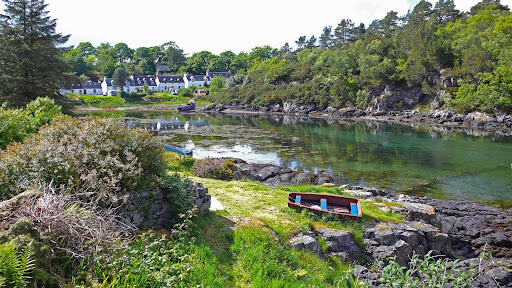
2 - Tidal Inlet with steel trestle bridge spanning end. This is supposed to be reminiscent of this inlet at Plockton. The structure i will be using is based on a lower version of this Austrian bridge and is produced by a company called N Brass Locos.

3 - The Vital Spark sitting at the "old quay". I love the Para Handy stories and had to include a Clyde Puffer (The Vital Spark) on the layout. I plan to have an operating mineral chute on the layout which will allow trains to discharge their load into the hold of the Vital Spark. The Puffer is based on the Dean's Marine kit, and is currently being built for use on Dunbracken but will be removed when PnC is started.


4 - Goods shed. This will be based on a combination of Irish prototypes with a curved corrugated roof similar to the Ratio carriage shed.

5 - Signal box and cattle dock - these will sit at the end of the platform for the goods shed.

6 - Castle. This will be a ruin of a small castle based on Castle Moil from the Isle of Skye.


7 - Beach with culverted stream from hills at rear of layout. This area is based on Plockton.

8 - Boat yard workshops, this is another building built for me by a friend, it was used on a previous layout and will be reused on PnC.

9 - Water tower - for this i have a very quirky prototype from an Irish line to use which was a cylinder lying on it's side with two domed ends and then sitting on a stone base.

10 - Steamer - this represents a small ferry vessel which would probably be sailing to the Hebrides, Ireland or to another Highlands port. At present i'm not 100% settled on a prototype, but it will be propeller driven.

11 - Station building - to sit opposite the ends of the lines running into the platform, from this building a short glass canopy will protrude out to the ferry steps and part way down the platform. This building will also contain an office for the ferry terminal.

12 - Church - probably based on the White Washed church seen in many photos of the West Highland line.

I realise that this trackplan is quite complex, but i think it will allow for some interesting operation. I wanted to give the feeling of the line once having operated to the yard and the "old" quay, and then having been extended to the "new quay", however with limited space here the run round facilities at the yard were still used. It's taken me a long time to get this plan to the state where i'm 100% happy with it, and i think there will only be small revisions to it now.

Tuesday, 1 July 2008

Making Tracks

I don't want this blog to start by solely being about what i'm going to do on PnC and moaning about how i think some commonly used products don't help realism of modelling, reading back through this is how it comes across to me. I don't want it to be of this opinion, what i'm trying to get across is that i'm by no means a fantastically talented modeller, but i want to try and create as realistic a layout as i am capable of, to do this i'm planning on using some different materials that suit my method of working better, and hope to share these with you as i go through both the planning and then construction stages of the layout. The thing i really want to create is the atmosphere of the line, and this may mean lots more scratchbuilding than i've done before to avoid using things like a GWR/LMS/Wills Freelance signal box for example, but this is something that i'm looking forward to.

One of the first products i found when investigating for PnC was Fast Tracks - this is an American company who produce... err... track making bits and pieces.

Their products i'm interested in using are:

Micro Engineering Spikes - actual spikes to spike the rail to the track rather than use chairs. This seems to have been common on many Irish lines, and therefore has been adopted for my PnC due to their similar nature (rolling stock, operation etc).


Micro Engineering Spikes source: www.handlaidtrack.com


The Tillig track i've used on Dunbracken gives a good effect of trackwork as can be seen below, but i would still like to try using more finescale appearing trackwork on PnC.


Parkside Dundas Vale of Rheidol guard's van sitting on Tillig HOe track on Dunbracken.


Wood Ties - actual wooden sleepers which will give a more realistic colour than pcb or rtr plastic sleepers. Some pcb sleepers will have to be used in the production of points, but this article is very useful for combining the wood and pcb and getting an even result from both mediums.


Wooden Ties (sleepers) source: www.handlaidtrack.com


PnC is very much inspired by Irish narrow gauge as well as Welsh and Scottish, and there is a photo of the Tralee and Dingle Railway which shows some very nicely wooden coloured sleepers with some light rust and grime staining. I think that to achieve this it will be much easier to start with wooden sleepers in the first place. At present Fast Tracks are the only i company i have managed to find that produce sleepers precut to close to 009 standards. They also produce some very useful looking point building tools which may come in handy when trackwork construction starts.