Monday, 8 February 2010

Change of plan


Having thought I'd finalised the track plan, I came across records of the Hebridean Light Railway proposal at the National Archive which include plans of the line. This got me thinking, and I'd like to model a station that was part of the proposed route from Armadale through to Broadford, then off towards Kyleakin, or Portree and then eventually branches to Dunvegan and Uig.

Whilst looking around Skye and looking at the trackplan Armadale began looking rather like Port na Cailliche in reverse, so I quickly doodled the trackplan crewdly on top of google
maps...


As if by magic the reverse layout seems to fit in perfectly! I'm now going to look at this in more detail, but I can see more fun to be had with a real location and planning how it would have developed with the railway arriving there.

Essentially it will be a flipped version of PnC, but I think I may have to loose the tidal inlet as it just doesn't seem to tie in with the coastline north of Armadale.

This might inspire me to pull my finger out and clear the loft... I did say might though!

Monday, 4 January 2010

Nearly there!


Happy New Year to anyone who reads this blog!

I am now in the rather slow process of clearing the loft to make way for the layout, it will be a fairly slow process as there is so much c**p up there! However, once clear I hope to have a nice modelling room which will allow for the layout to be up all the time and create some storage underneath.

Over the holidays I came up with a sketch of a loco design based on a combination of North British Railway tank locos, this is likely to be based on a Graham Farish 08 chassis using Backwoods Miniatures valve gear.


I'm hoping to make a start on this to coincide with the testing of the track on the new layout so that it can be the first loco to properly turn a wheel on it.

Finally, I've decided on the form of the baseboards, I will be using the same principal as Pempoul (so it can't be bad!), that is a ply outer frame to provide some rigidity and an extruded (pink) foam insulation centre for the running surface and scenic foundation. This should prove strong and lightweight, the latter being important as it will take two people to man handle (or should that now be person handle) the boards down from my loft!

Thursday, 24 September 2009

Paint, what paint??


Developing on the latter part of my last post... The plan to build the layout with some friends building other layouts that will make it a modular affair (albeit rather large) eventually is good fun. Ideas are bounced about, and one such recent idea was to move the period the layout is set in to pre-grouping.
This would mean moving the period from the 1930s to somewhere in the region of 1913. Ultimately this means that the line could have been operated by the North British Railway. There seems to be surprisingly little information recorded about the NBR in a country that has managed to preserve plenty of history about the other lines of the era.

Paint is a real issue, there were several different liveries carried by the NBR, but periods that these were used over seem rather vague, and there were some locos that overlapped from one period to another anyway. Phoneix paints produce some NBR colours, however I find them difficult to achieve a good finish with compared to other brands of paint.

Instead, from looking at photos of a preserved NBR loco (Glen Douglas), I found Citadel Colour 'Gretchin Green' foundation paint.


The colour is a close enough match for me to be happy. Now to try and sort out how to do the lining!!

Saturday, 22 August 2009

A little more history

I've been doing some research recently into proposals for Scottish narrow gauge lines in some of my books. In 1896 the Light Railway Act was passed, and two years later there were 35 proposals in one year for light railways in Scotland, some brand new schemes, and some revivals of old ideas. There are some quite interesting proposals, one of which particularly captivated me.

The Hebridean Light Railway Proposal was to build lines on the Isle of Skye and The Isle of Lewis that would total a running distance of 97 miles. The main route on Skye was the one that interested me, this could potentially make the ideal setting for Port na Cailliche. The route proposed ran from North to South along the island with branches to Dunvegan and Uig. Other stations on the route mentioned are Sligachan, Broadford and Isleornsay. The intention was to take all traffic from Isleornsay to Mallaig where it could meet up with the North British Railway's West Highland Line. Therfore the line would likely have been operated by the NBR.

For whatever reason this proposal did not materialise. In 1898 the Highland Railway were invited to build a line on Skye from Portree to Dunvegan with a branch to Uig, again this did not materialise.

In 1980 'railways for the islands' were considered by a government comission, but again did not prove fruitful. There was strong opposition to any building of a line from the Highland Railway, this was likely to be because it would have been an NBR funded/operated scheme.

One line did materialise on Skye in 1904, a 3' gauge line from a marble quarry in Torrin to Broadford pier. It employed a Kerr Stuart Skylark (from 1910 onwards) and operated until closure in 1939.

From reading this it occurred to me that Port na Cailliche could be located on the Isle of Skye, and could have been a new port (like Mallaig) built to improve access to fisheries and ferry navigation routes. A likely location would be on the South Western corner of the island due to the shorter route to Mallaig by sea. Likely traffic could have been passengers to and from the Islands to meet ferries, local passengers, rock, fish, inter-island goods etc.

I decided to keep the location fairly imaginative and just leave it as 'somewhere in the Lochaber region', thus enabling me a bit more freedom with my plans, and with the history.

One thing that the reading did make me realise though, was that it would be different to set the line pre World War 1 in a period when it was operating at it's heyday rather than in the 1930s. Many narrow gauge lines would have been in decline by the 30s, so a more interesting range of operations could probably be modelled if set pre-WW1. Anothe thing that occured, was the possible ownership/endorsement by the NBR, so I will be experimenting with NBR livery on a loco kit and some stock that I am working on at present to see how it turns out.

Dunbracken is to be exhibited at ExpoNG in October, realistically before this I don't think i'll have time to get anything done on PnC, but after that it will be full steam ahead for the winter to make a start on the baseboards!

Sunday, 14 June 2009

Trackplan!

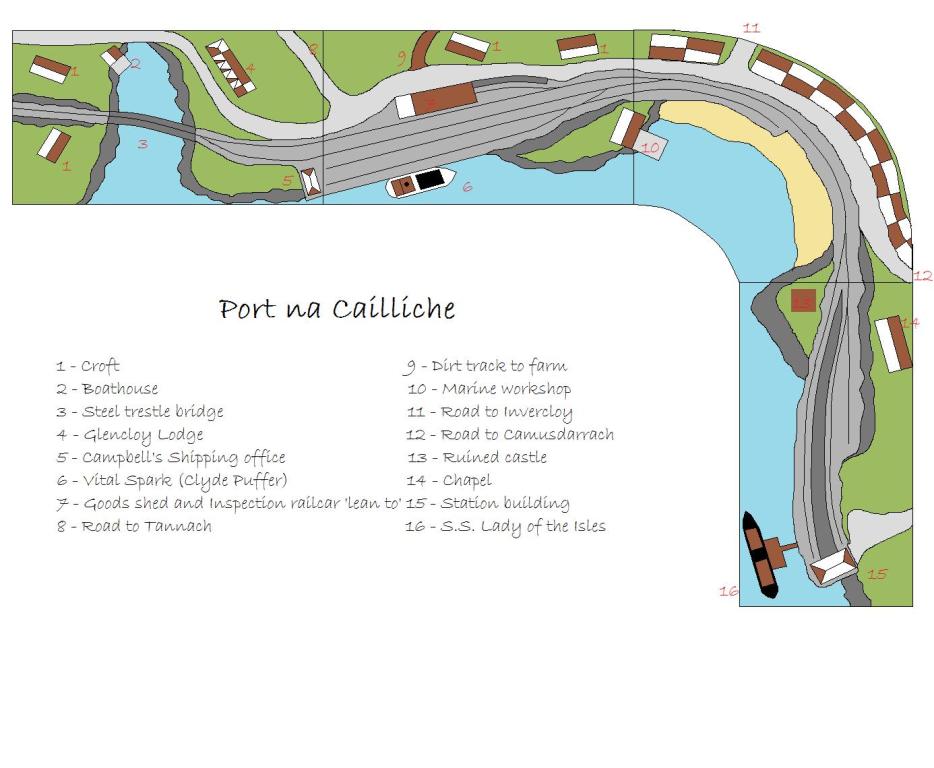
Here’s a copy of the revised trackplan as promised… it’s got the right angled bend in it to make it take up less space in the loft, whilst still retaining the feel of the curvy design.

Click here for a larger copy to look at

Now that this if finalised, just to plan the construction of the baseboards now… woodwork, not something that I get on with too well!

The other Lochaber Railway

Those of you who have been reading my blog for a while may have heard me refer to the Lochaber Railway which ran from the pier at Fort William up around the edges of Ben Nevis and Aonach Mor to Loch Treig.

I’ve recently returned from a holiday in the highlands, and have had a lot of inspiration for the layout. It has not made me change the trackplan for PnC in any way from the last revision, but has given me ideas of specific buildings to use of the layout. One thing that I did decide to do whilst there was to give the layout a sense of place, a location better than ‘somewhere in the Scottish Highlands’.

To do this I’ve decided to locate it on the edge of the Lochaber region, and give some subtle hints to this within the layout, and the history that will accompany it. In Fort William I purchased a very helpful book of historic photos of the Lochaber region:

Source: www.alibris.co.uk

From reading through this book I’ve decided to give hints to the region, such as having the local store named ‘Nether Lochaber Stores’ which had a branch in Onich run by John Mackinnon. It is highly possible that Mr. Mackinnon could have opened another branch of the Nether Lochaber stores at Port na Cailliche.

The Nether Lochaber Stores, Onich - Source: www.theoldstore.co.uk

Road signs and busses to Fort William (the largest town in the Lochaber Region) will also help to give the layout a better sense of place.

What was also interesting was to get a better understanding of the narrow gauge railways that existed in the Loch Leven area whilst staying there. The two that I looked at were the Kinlochleven Railway that ran through the village of Kinlochleven, and the quarry line at Ballachulish.

The Kinlochleven line was built to carry bauxite and other materials to the plant, and then aluminium to ships at the loch. It was operated by electric locos in it’s final years.

Route of the Kinlochleven Railway since closure - Source: http://canmore.rcahms.gov.uk

Kinlochleven Aluminium Works Pipe Line - Source: www.grough.co.uk

The Lochaber area accounted for about a third of the world’s aluminium production in the early 1900’s, so a third plant in close proximity is feasible. I’d like to have one of these plants located somewhere on the railway network attached to PnC, and given that PnC is supposed to be relatively close to Fort William it is feasible.

I’m going back to Scotland in September, so hopefully I can try and walk the route of the railway if time permits.

I know very little about the Ballachuilish line, other than there was a small narrow gauge line built to carry slate from the nearby quarry to the Caledonian branch from Oban. I will investigate this further in the future for personal interest.

Ballachulish Quarry - Source: www.undiscoveredscotland.co.uk

I was suprised to see a structure that has mainly Welsh narrow gauge associations though: a quarry incline made of slate! I’d not noticed it before, but will go for more of a wander around it when I’m there in September if possible.

Ballachuilish incline – Source: www.flickr.com

I think given that both a quarry and an aluminium plant existed in the area anyway, to add more of the same onto my line wouldn’t seem out of place for the area. However, I don’t want to have slate trains, I think i’d rather have something more associated with Scotland than slate is… granite perhaps?

Finally, on the way home from Scotland we stopped in the Lake District. Whilst there we rode on the Ravenglass & Eskdale Railway. I’ve always had a soft spot for their logo, so i’m tempted to adapt it for my line. I’ve got an idea, but need to draw it out a bit more presentably before showing it online!

Ravenglass & Eskdale Railway emblem

Tuesday, 26 May 2009

Future proofing

When designing the layout I was thinking of it being a standalone layout that would operate independently of anything else.  One source of inspiration for this layout is Ted Polet’s Craigcorrie & Dunalastair Railway which operates on two levels. 

I’ve always thought this was a good idea as it has allowed Ted to model near enough a whole line.  This brings in levels of operation that you would expect to see on large American basement layouts, but not in something that occupies a space of about 10’x6’.

Consequently, I may well revert to the more right angled design of the layout plan that was posted originally, but adapt the layout of everything on the existing plan to fit into the ‘new’ (old?) shape.  This should make it a much more practical shape, whilst still allowing me to represent the curve for the Plockton board.  It will also hopefully future proof it a little by making it much more likely to fit into rooms if and when we move house.  I don’t want to loose the individuality of the design however, so part of the the curve will be retained rather than it simply becoming an L shape with right angled edges.

Hopefully this will make it the ideal base for me to some time begin my own double decked plan that I drew out years ago.

I’m aiming to begin ‘proper’' work on the layout during July rather than waffling here about the planning stage.  I’ve had a lot of time consuming things to deal with recently, and not enough spare time for me to get on with building a layout once more mundane things are done.  Hopefully that can be put right soon, and progress will be shown here over the coming months.